


At a glance: Planning a corporate catering party comes down to seven decisions made in order: purpose, budget, guest count, venue, service style, menu, and booking timeline. Handle these in the right sequence, and the details fall into place.
A successful corporate catering party comes down to seven decisions made in the right order. Handle these in sequence, and the details fall into place.
The reason for the event shapes every downstream decision. A corporate holiday party, product launch, client appreciation dinner, sales kickoff, corporate meeting, or retirement celebration each calls for a different tone and menu approach.
Common corporate event purposes include:
If you can’t name the purpose in one sentence, the event brief still needs work before you talk to a caterer.
Most teams set the total budget first, then work backward into headcount, service style, and menu. Divide your total budget by your expected headcount to land on a per-person target, and allow 10 to 15 percent extra for beverages, gratuity, and add-ons.
Gallup workplace research consistently links employee engagement to better performance and longer tenure, which means even a routine team lunch is a small investment in retention. That framing is worth having ready when justifying the spend to finance or leadership.
Corporate catering pricing varies significantly by service style, menu complexity, and delivery format, so your per-person budget will guide which of the next steps are open to you.
Lock in your guest count range early. Most corporate catering services require a minimum guest count, and pricing tiers often shift as your headcount grows. Ask early:
Your final headcount confirmation typically happens the week before the event, but your caterer needs a working range at booking to build the right proposal.
Your venue drives many downstream decisions, so lock this in before finalizing the menu. Common corporate event venues include:
Popular Q4 event venues in Tampa Bay book 3 to 6 months ahead. If your event falls in November or December, start venue conversations by late summer.
Before locking in a venue, confirm a few catering-critical logistics:
Your caterer will need answers to all of these once the venue is booked.
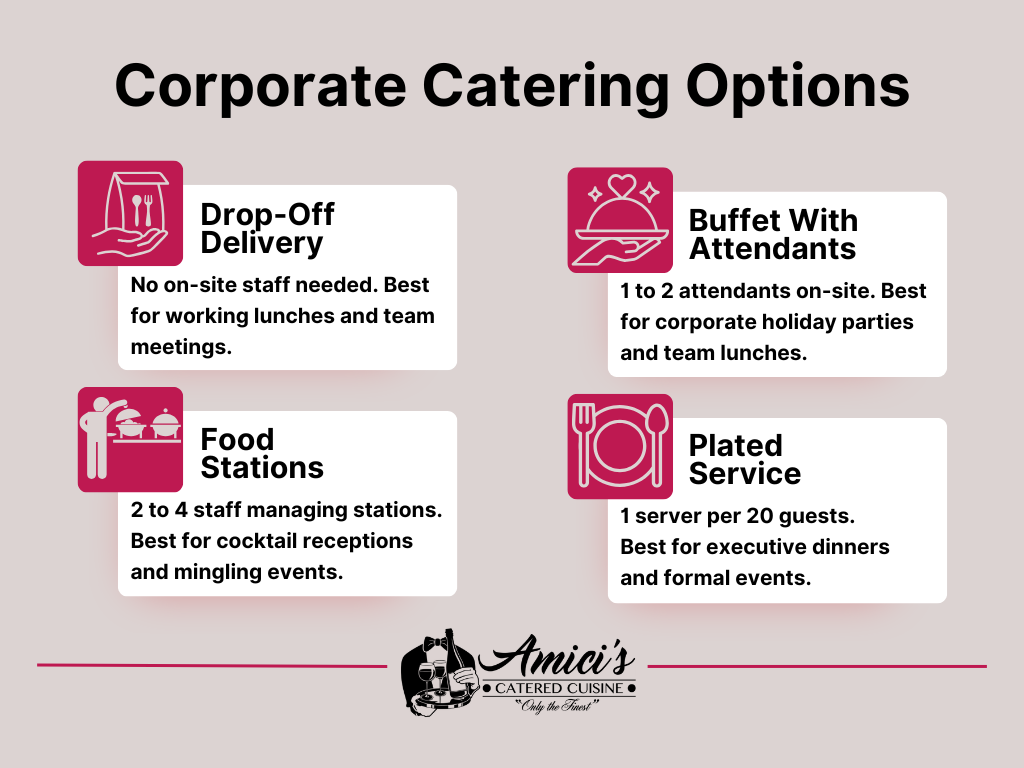
Service style shapes both guest experience and cost. Match it to your event’s formality and pace using the four most common options:
Drop-off catering works when your team can serve themselves and cleanup is minimal. Buffet service adds attendants who refill dishes and manage traffic. Food stations work well for cocktail parties where guests mingle and graze. Full-service plated dinners suit your most formal corporate events and executive gatherings.
The best part of working with a corporate caterer is that you don’t need to design the menu alone. Your job is to bring the details about your event, your guests, and any dietary needs. Your caterer builds the menu around that information.
Here’s what to share when you start the menu conversation:
Event context:
Guest details:
Beverage needs:
A quality corporate caterer will take that information and design a menu that fits your budget, matches your event’s tone, and accommodates every guest at the table. Dedicated vegan, vegetarian, and gluten-free menu items should be standard, not something guests improvise from the main menu.
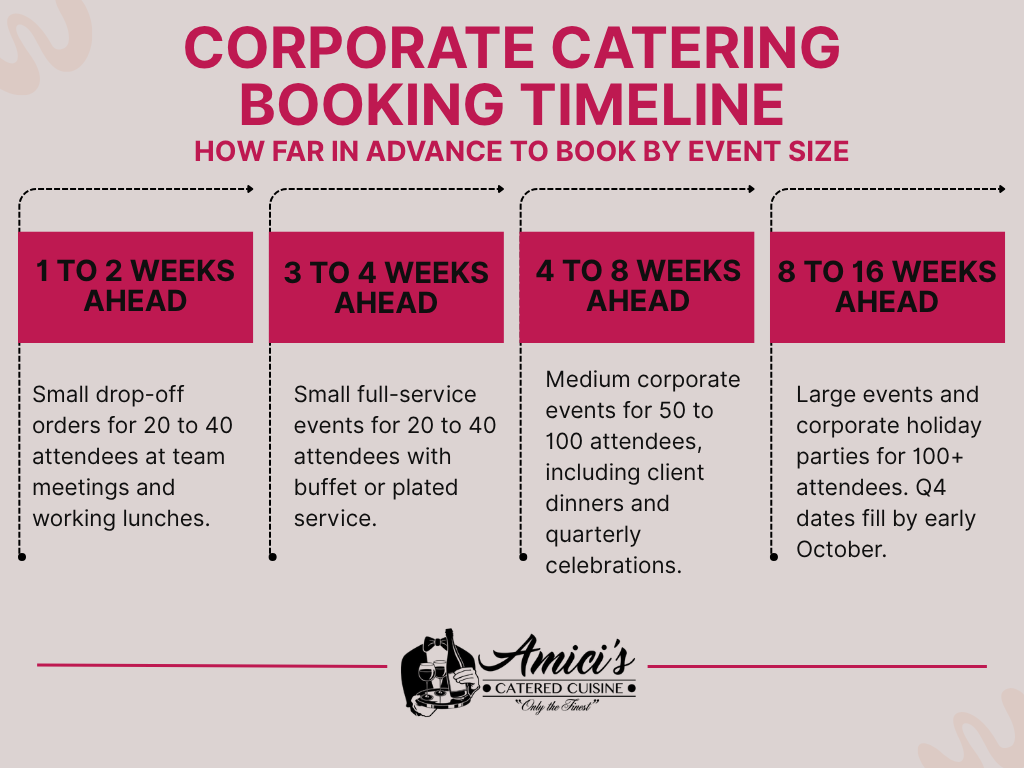
Booking timelines depend on event size and season. The earlier you lock in a caterer, the more menu customization, service style flexibility, and date availability you’ll have to work with.
Standard booking windows by event size:
Popular Tampa Bay caterers often fill their Q4 calendars by early October, so start conversations by late summer if your event falls in the holiday season.
When you’re ready to reach out, ask potential caterers about:
The right caterer will answer these questions confidently before you sign anything.
The week before your event, walk through this checklist with your caterer:
Share a run-of-show with your caterer if the event has scheduled program elements like speeches, awards, or presentations. Your catering team can pace service around the agenda so team members enjoy each course without missing key moments.
Since 1984, Amici’s has been one of Tampa Bay’s most trusted corporate catering teams, serving small team lunches, holiday parties, and full-scale corporate events across the region. Our kitchen and service team averages 15+ years with Amici’s, so the same people planning your event are the ones executing it on the day. Every Amici’s proposal includes a flat 20 percent gratuity built into the total, so there is no guessing or additional tipping expected at the end of the event.
Our pan-based, mix-and-match menu system combines Italian, BBQ, Mediterranean, and coastal options with dedicated vegan, vegetarian, and gluten-free menu items so every team member has something to enjoy. As the 2025 Hospitality Business of the Year, an NMSDC-Certified Minority Business Enterprise, and a three-time NACE Caterer of the Year, Amici’s is the preferred corporate caterer at over 100 banquet halls across Tampa, St. Petersburg, Clearwater, and the surrounding Pinellas, Pasco, and Hillsborough counties.
Contact us today to start planning your next corporate catering party.
Corporate catering pricing varies by service style, menu selection, and guest count. Boxed lunches and drop-off catering options sit at the most budget-friendly end, buffet catering with staff falls in the mid-range, and full-service plated meals land at the premium end. Every Amici’s proposal is quoted per event based on your menu, guest count, and staffing needs.
Plan about one pound of food per adult for a full meal service. For hors d’oeuvres receptions and cocktail party events, plan 6 to 8 pieces per guest for a one-hour event and 10 to 12 pieces per guest for a two-hour reception with no full meal.
Book small drop-off orders 1 to 2 weeks ahead, mid-size events 4 to 8 weeks ahead, and large events or holiday-season corporate parties 8 to 16 weeks ahead. Q4 corporate holiday party dates fill fastest and typically require booking by early October.
A good rule of thumb is to hire licensed bartenders for any corporate event serving alcohol to 30 or more attendees. Professional bartenders manage pacing, monitor for over-service, handle liability concerns, and free your team members to focus on hosting rather than pouring drinks.
Yes. Experienced corporate catering services routinely accommodate vegan, vegetarian, gluten-free, dairy-free, and allergy-specific dietary needs at the same event with clear labeling and separate prep to prevent cross-contamination.


